Raiding barbarian villages for resources
Your own production is only part of your income. The rest sits in the barbarian villages around you, waiting to be collected one raid at a time.
Why raid at all
Your Lumber Mill, Brickworks and Ironworks produce every hour, but the Storehouse holds only so much. Once it is full, whatever is produced beyond its capacity is lost, and so is any loot that comes home to a full Storehouse.
Barbarian villages have their own mines, and nobody spends what they produce. Every time you take their stock, it starts filling up again. A steady stream of raids brings you more resources than your own production, and brings them earlier in the game than anything else can.
So the rule is simple: spend what you have, keep the Storehouse from overflowing, and send troops out to fetch more.
Which villages to hit
Grey villages on the map belong to barbarians. Most of them have no troops and no wall: they are small settlements with a little of each resource. Villages a player has abandoned are the exception. They keep whatever army and wall they had.
Closer is better. A raid that comes home quickly can go out again quickly, and your troops are at risk for less time. A light cavalryman needs 10 minutes per field at the base unit speed, and world settings make that faster, but distance still decides how many trips you get in.
Bigger villages have more to take, but they are also where surprises hide. Look at the last report before you send again: the Assistant shows whether the last attack came home with a full load, with partial loot or with losses.
Which troops to send
What a raid brings back depends on what your surviving troops can carry. Each light cavalryman carries 80 resources, each spearman 25 and each axeman 10.
Light cavalry are the raiders. They are fast, they carry the most, and they hit hard enough for an empty barbarian village. Axemen are slow infantry and carry little, but they win fights, so use them where there are defenders. Spearmen carry well for infantry, but they are defenders, and every spearman out raiding is one fewer guarding your village.
Size the raid to the loot. Too many carriers waste a trip; too few leave resources behind. The report shows how much came back against how much your troops could carry, and marks a full load.
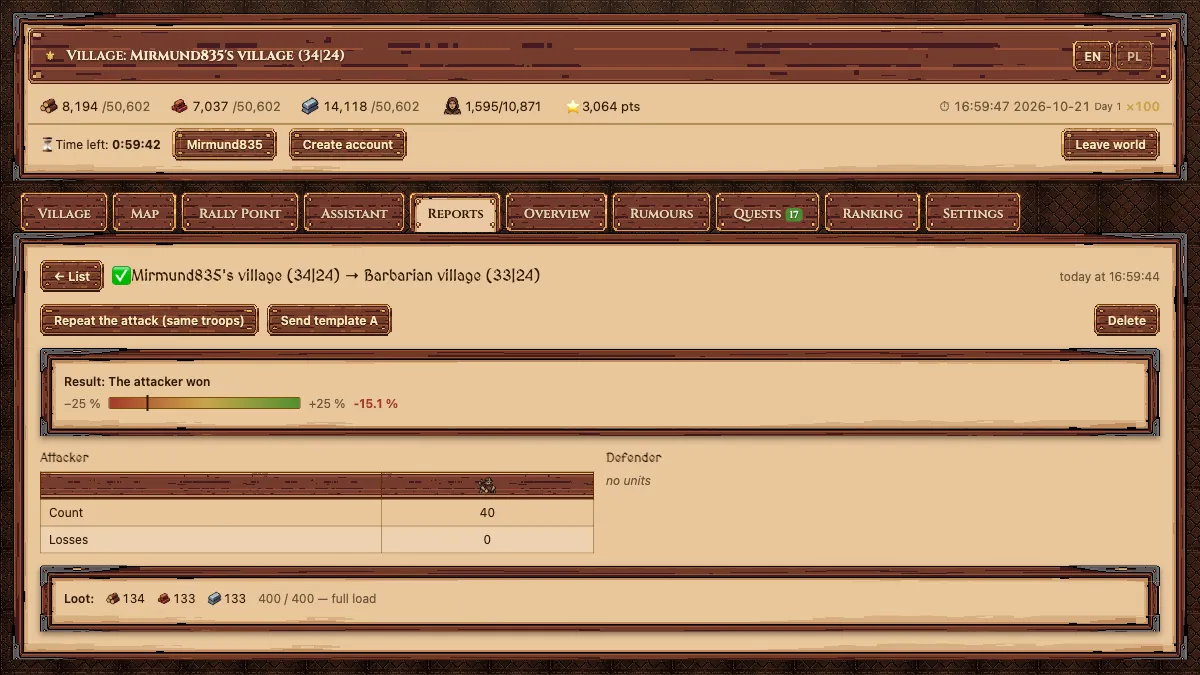
The farm assistant and templates
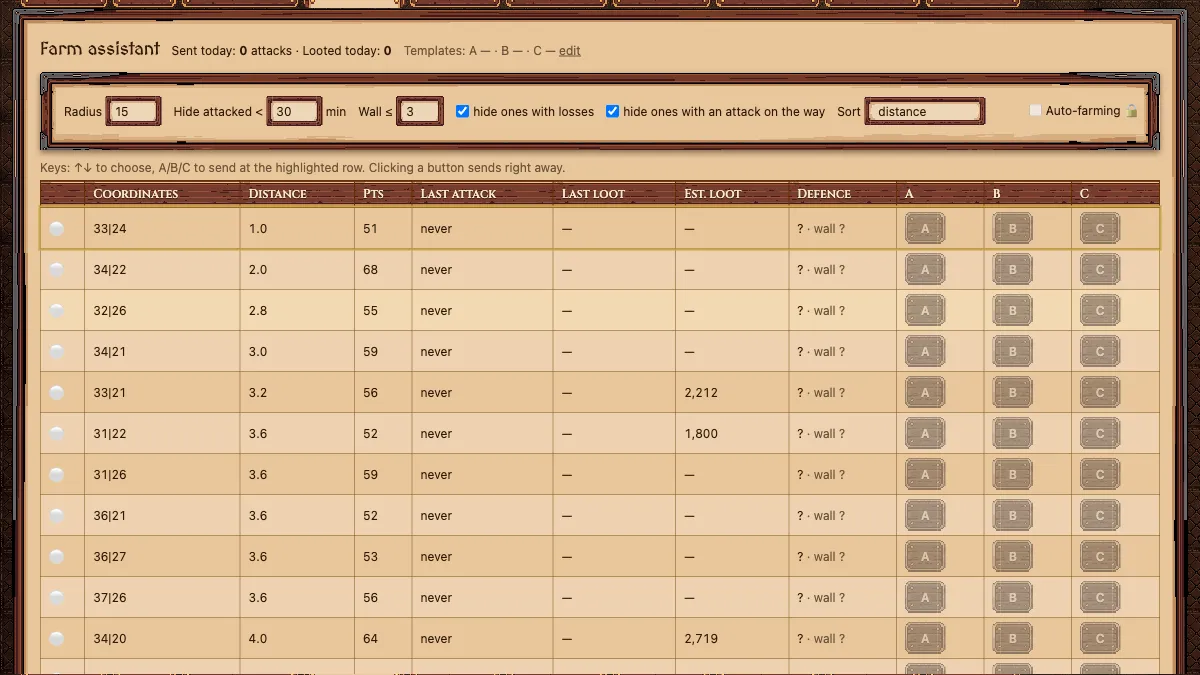
The Assistant lists the barbarian villages within a radius of your current village: distance, points, the last attack, the last loot, the estimated loot and the defence you saw last time. Filters hide villages you attacked a moment ago, villages with a wall above the level you choose, villages where you had losses, and villages with an attack already on the way.
Templates are saved troop sets. Set up A and B once, in the Rally Point or with the edit link in the Assistant, and a single click sends them at a row. Template C is a pack: the Assistant sends as many packs as the estimated loot needs. On a keyboard, the arrow keys move between rows and A, B or C sends.
Auto-farming unlocks when you have 3 villages, or earlier through the Raider quest. Turn it on for the villages you choose, and every 15 minutes it sends template A at the targets that pass your filters, nearest first, for as long as the troops last.
Risks: scouting, the wall and the hideout
Scout first when you are not sure. A few scouts tell you the troops, buildings and resources of a village before you risk an army.
A wall costs you troops. Every level makes the defence stronger, and even an empty village with a wall makes the attackers pay in losses. That is why the Assistant hides villages with a higher wall than you allow.
A Hideout protects part of a village's resources from raiders. A barbarian village with a Hideout keeps that part out of your reach, so the estimated loot is smaller than its full stock. A scout report shows everything in the village, the hidden part included, so do not count on all of it. It works the other way too: your own Hideout keeps part of your resources out of other players' reach.
Finally, raids are attacks. Players see them coming at their villages, and a raid that passes close to another player's village can be caught on the road.
Read more
Light cavalryman · Axeman · Spearman · Storehouse · Hideout