Defending your village: incoming attacks, support and dodging
Sooner or later someone attacks you. Defence in LibreHold is about seeing it coming, having the right troops at home and deciding in time whether to hold or step aside.
Seeing an attack coming
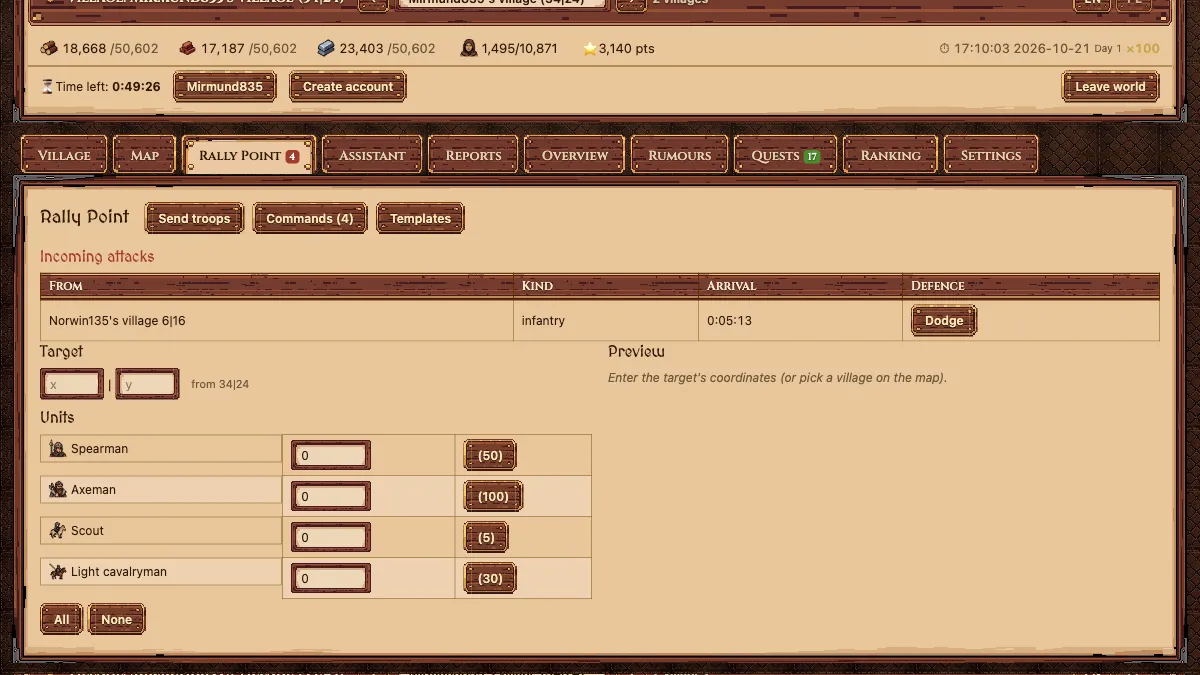
Attacks on your village appear under Incoming attacks, both in the village view and in the Rally Point. Each row says where the attack comes from, what it probably is and how long until it arrives. The kind is a guess read from the march time: the slowest unit sets the pace, so an attack moving at a hetman's pace is marked “hetman?”. Several hetmans landing right after each other are flagged as a train.
On the map, an incoming army is drawn along its road. Clicking it opens a card with the same facts and the exact arrival time.
The game can also ring a bell. Turn on Sounds in Settings and you hear an alarm when an attack on your village lands while the game is open. It is not a wake-up call: it sounds when the attack has arrived, not before. For an attack that lands while you sleep, look at the arrival time and set an alarm on your phone.
There is no night bonus
There is no night bonus in LibreHold. Your village defends exactly as well at three in the morning as at noon, and nothing slows an attack down because you are asleep.
The only shield the game gives you is beginner protection. On long worlds it lasts 7 days by default, and the admin of each world can set it anywhere from none to 30 days. In an instant game it lasts 10 minutes. While it lasts, nobody can attack you, and you can attack only barbarians.
Bots know all this. On long worlds they like to time attacks for your night or for the hours when you are usually away, which they read from when your points stop growing. Some learn when your troops come back from a dodge and land right after. Plan your defence for the hours you are offline, not the hours you are watching.
Holding: the right troops, the wall and support
Good defence depends on what attacks you. Spearmen are cheap and stand well against cavalry, with 45 defence against it each. Swordsmen are the answer to infantry such as axemen. Archers defend well against both infantry and cavalry. A mix of all three covers you against whatever arrives.
The Wall multiplies everything. Each level adds defence and makes the whole garrison stronger, so it is usually the best building to raise once attacks start.
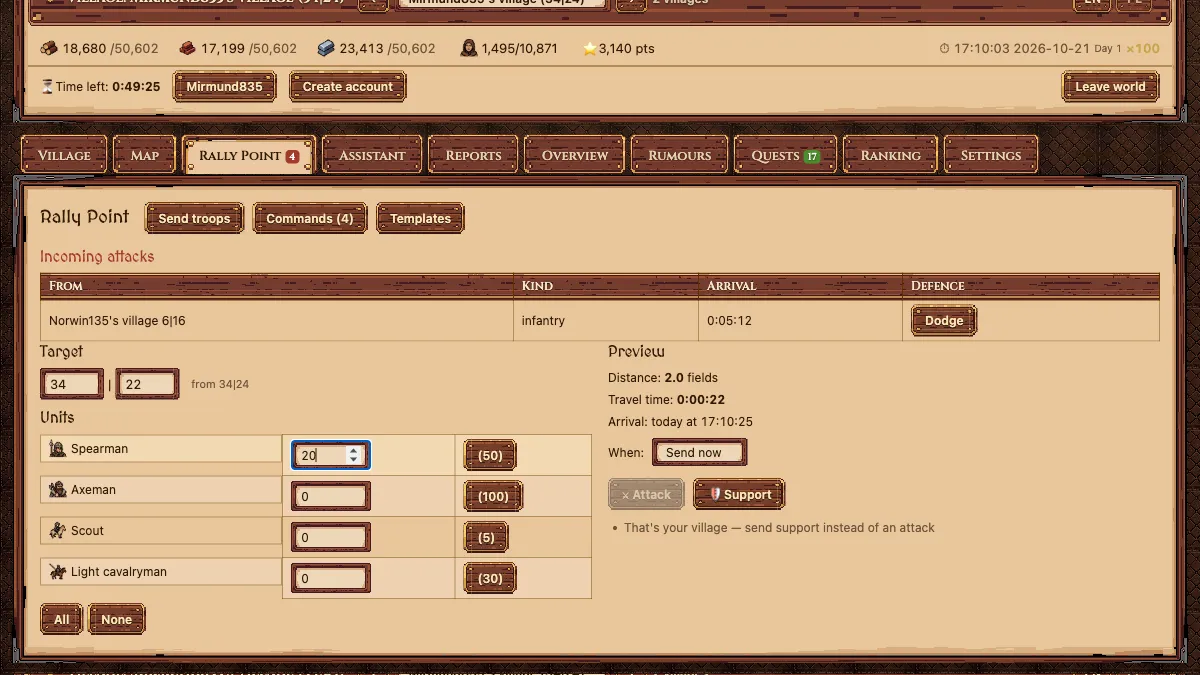
You do not have to hold alone. Support from your other villages fights in the battle as if it were your own army, and so does support from friends: anyone can send troops to your village, and you can send them back from the Rally Point when the danger has passed. The Arrive at mode lets you time support so it lands before the attack.
Against a hetman train there is a sharper tool. Snipe sends support that lands between the first and the second hetman, so the hetmans behind the first meet a fresh garrison.
Dodging: stepping out of the way
Sometimes an attack is too big to hold. Then the best defence is to be somewhere else: send your troops out before it lands and bring them back right after. The attacker finds an empty village, takes some resources and kills nobody.
Any army can be recalled during the first 10 minutes of its march, and it takes as long to come back as it spent going out. That is the whole trick, and the Dodge button does it for you: all your troops leave as support to your nearest village, or as an attack on a nearby barbarian village, and turn back so that they arrive home a second after the hit. Because of the recall window, you have to press Dodge early enough, roughly two such windows before the attack lands.
Dodging is right against a large attack that would wipe out your garrison. It is wrong against hetmans: an empty village loses loyalty to every hetman who arrives. Against a train, hold, snipe or call for support.