Scouting and armies on the road
Information wins more battles than troops do. Scouts tell you what waits in a village, and the map shows you the armies marching past your land.
Scouts and scout reports
Scouts are trained in the Stable. They are the fastest unit in the game, 9 minutes per field at the base unit speed, and they carry nothing. A scouting mission is an attack made of scouts only; scouts mixed into a normal attack simply march along with it.
When your scouts arrive, they meet only the defending scouts, and each defending scout counts 2 times. If your scouts are stronger, they get through, some of them may die, and the report shows the village's resources, buildings, troops (support included) and loyalty. If not, every scout dies and the report says only that the scouting failed. The defender loses nothing either way.
So send more scouts than you think you need, and keep some at home: your own scouts are the only thing that stops other players from looking inside your village.
What you see on the map
Every attack aimed at one of your villages is visible to you from the moment it sets out. Other armies are visible too, as long as they pass close to one of your villages. The sight radius, counted in map fields, is 1 on long worlds and 5 in instant games, where armies cross a field in seconds and you need to see them earlier. If a world has field battles switched off, you see only the attacks on your own villages.
Click an army on the map to open its card: where it comes from, where it is going, when it arrives and what it looks like, judging by its pace. From the card you can scout it or attack it in the field, and if it is coming at you, dodge it.
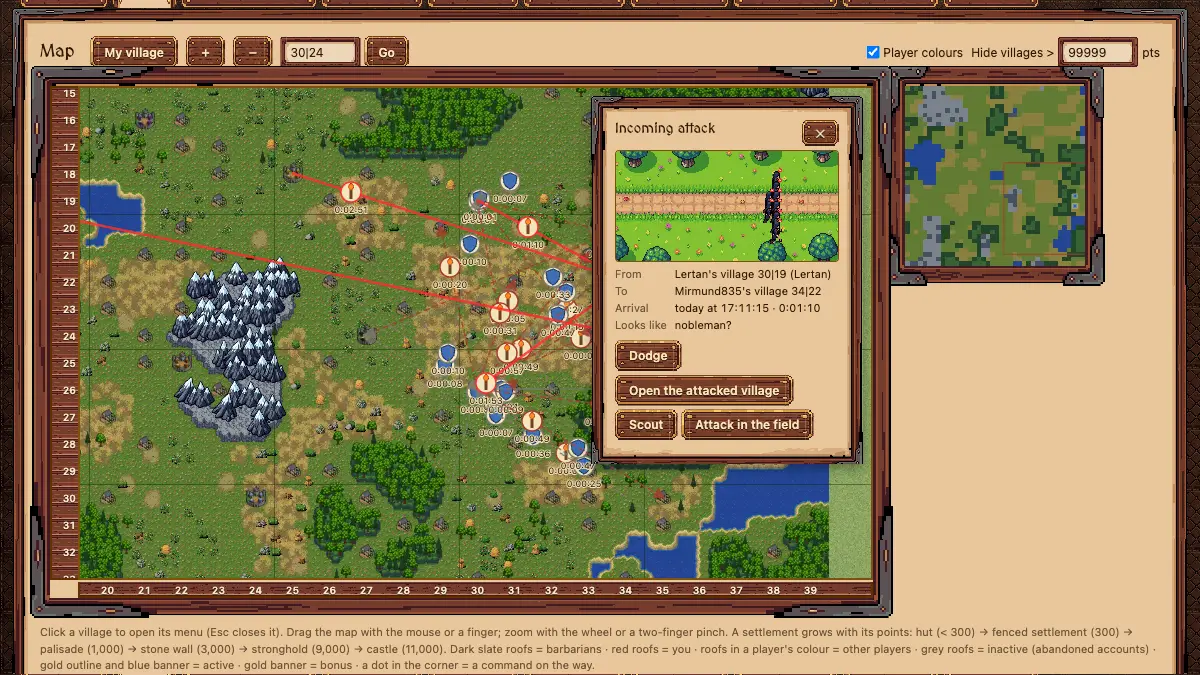
Meeting an army on the road
Scout and Attack in the field send your troops to meet an army on its road. The game works out the meeting point when you send them and shows when they will get there; if your troops are too slow to catch it, it tells you so straight away.
A field scout works like scouting a village, against the scouts in that army, and shows exactly what marches in it. A guess like “hetman?” becomes a fact.
A field battle is fought without a wall, because there is none on a road. That makes it the cheapest moment to hit an army: a handful of horsemen can destroy a column of axemen and its hetman before it ever reaches your village. Axemen defend badly against cavalry, and in the open nothing helps them.
If the army you hit was carrying loot, its survivors keep what they can carry, your survivors take what is left up to what they can carry, and the rest is lost on the road. If the army has turned back or arrived before your troops get there, they find nothing and come home.
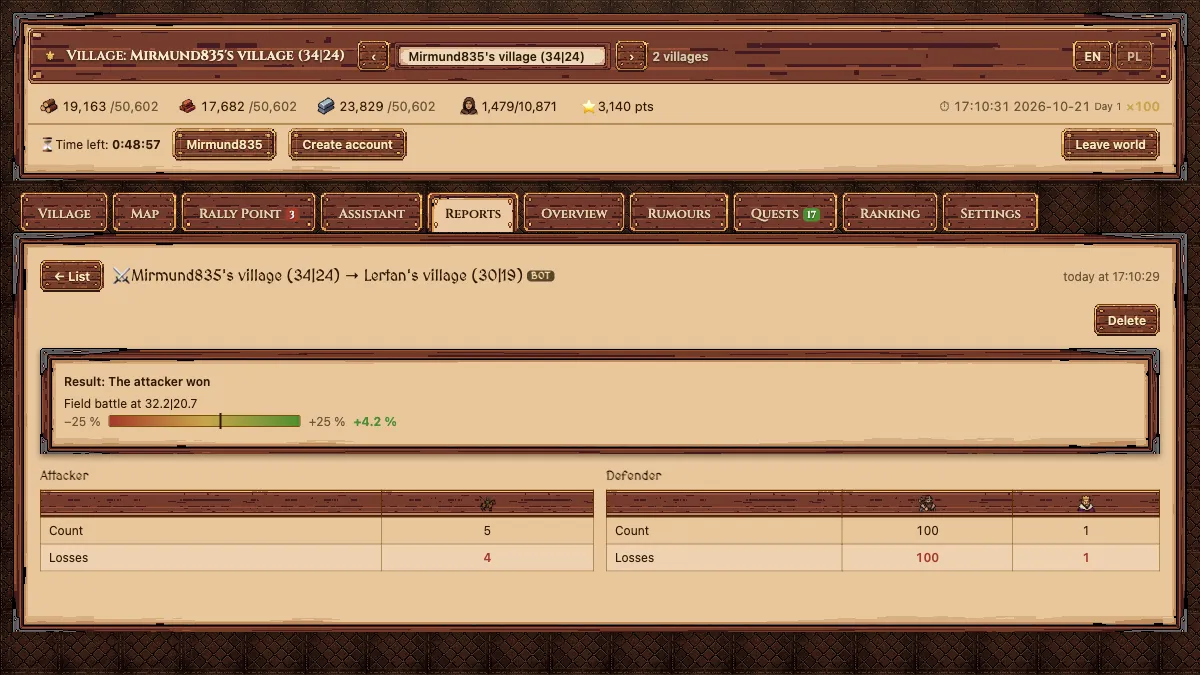
Turning back
Normally an army can be recalled only during the first 10 minutes of its march. An army that has been hit in the field is different: it may turn back at any moment until it arrives. If your attack is caught on the road and loses half its strength, you do not have to throw the rest at a defended village. Open its card and press Turn back.
The other side knows this too. When you hit an army on the road, expect what is left of it to turn round rather than walk into a defence that is now too strong for it.
The way home takes as long as the march so far. The later your troops turn back, the longer they are away, and an empty village is an easy target.