Hetmans and conquest: taking another village
Hetmans are how one village becomes many. They are expensive, slow and fragile, and getting them to the target alive is the whole art.
The Academy
Hetmans are trained in the Academy. To build it, you need a Town Hall at level 20, a Market at level 10 and a Smithy at level 20. On a long world that is a long way from the start, and reaching it is the first big goal of every player.
The level of the Forge is also a limit: a village can hold as many hetmans as its Academy level, counting the ones in training and the ones on the road. Raising the Forge lets one village prepare several hetmans at once.
A hetman is the slowest unit in the game, and he can attack only villages up to 70 fields away. Plan your conquests around the villages within that reach.
Coins
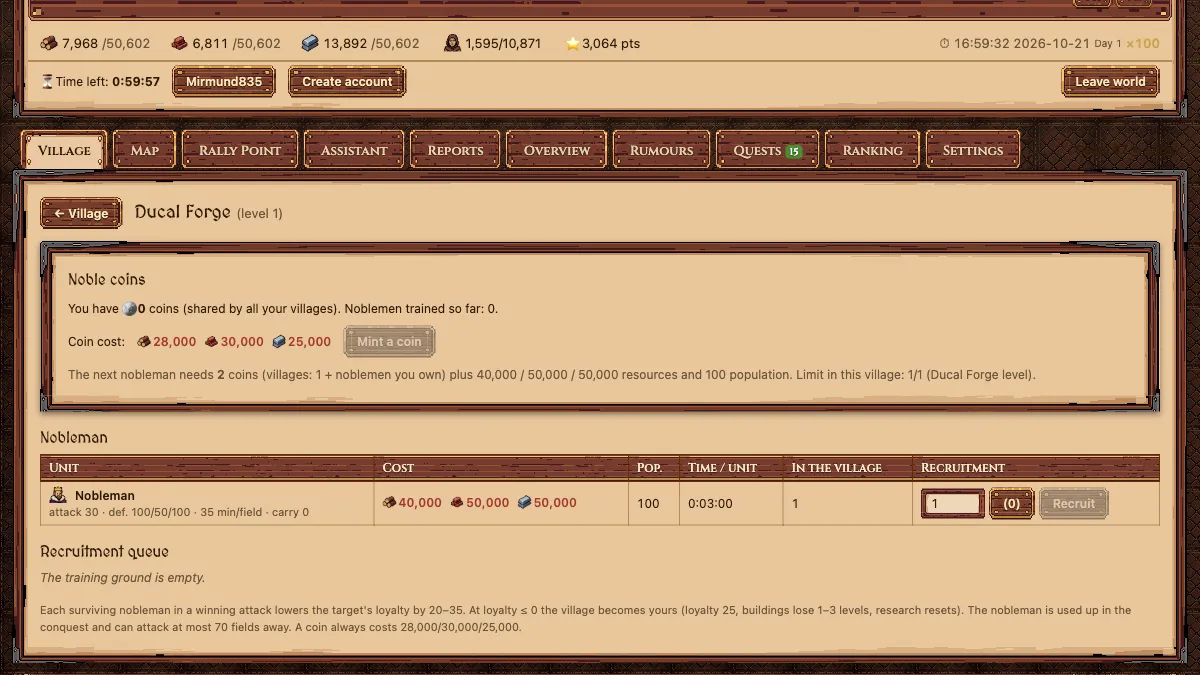
Besides his own cost, every hetman needs coins. You mint them in the Academy with Mint a coin, and a coin always costs 28,000 wood, 30,000 clay and 25,000 iron. Coins belong to you, not to a village: all your villages share them.
The coins a hetman needs are the number of your villages plus the number of hetmans you already own, including those in training and on the road. Every new village and every waiting hetman makes the next one dearer. A hetman who dies or is used up in a conquest stops counting.
This is why raids matter so much before a conquest. Coins eat resources faster than any building does, and the barbarian villages around you are where most of those resources come from.
Loyalty
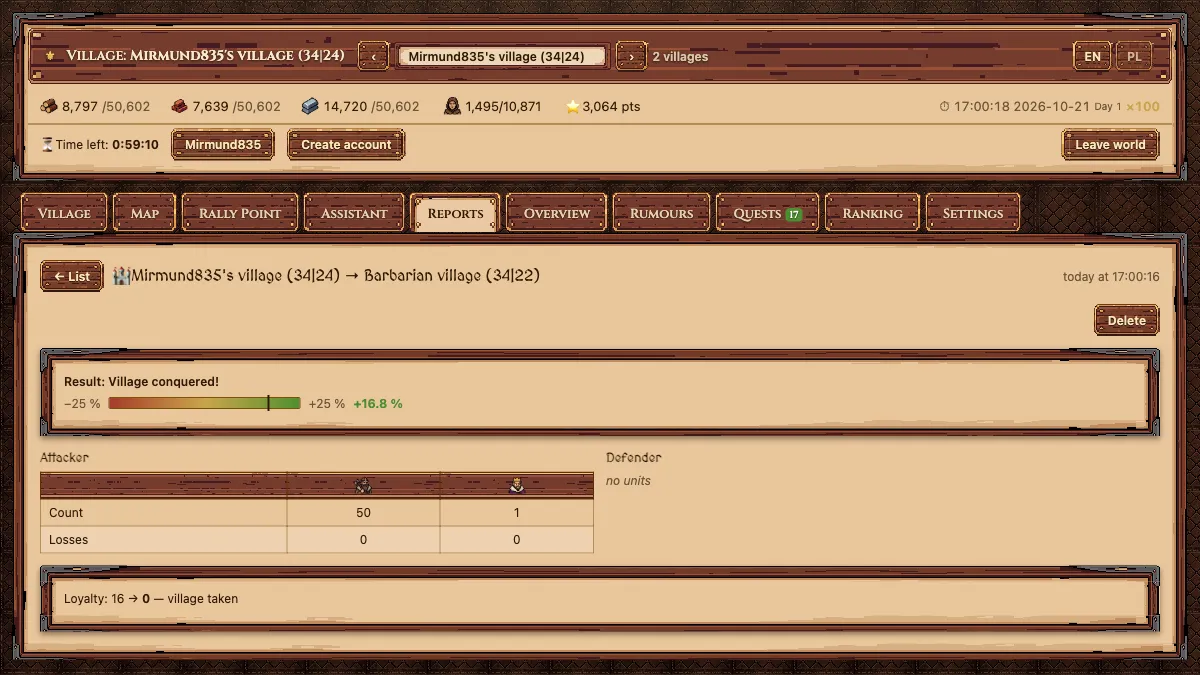
Every village has loyalty, at most 100. Each hetman who survives a winning attack lowers it by a random 20 to 35. When it falls to zero or below, the village is yours and that hetman is used up; any other hetmans in the same attack go home.
Loyalty grows back by one point per hour, multiplied by the world speed, so a slow conquest undoes itself. After a conquest the village starts at 25, which makes it easier for the old owner to win it back at once.
A conquest costs the village too. Every building loses 1 to 3 levels, though the Town Hall never drops below its first level. Research starts from zero, the queues are cleared, support stationed there is sent home, and the previous owner's troops that were away from it are lost.
On long worlds a player's last village cannot be taken by default: hetmans stop just short of zero. Abandoned accounts are the exception. In instant games the last village can be lost like any other.
Clearing and the hetman train
Hetmans fight badly. If the attack loses, they die with everyone else, and even in a winning attack they can fall. Clear the village first: send a large attack with axemen, light cavalry and rams to kill the defenders and bring the wall down, and send the hetmans right behind it.
Several hetmans landing one after another make a train. Use the Arrive at mode in the Rally Point so that each attack lands a moment after the one before: the clearing attack first, then the first hetman with a solid escort, then the others with smaller ones. With only fractions of a second between them, the defender has almost no gap to slip support into.
You can also put several hetmans into one attack. Each of them lowers loyalty, but if that attack loses, they all die together. A train spreads the risk.
Strike when the owner is not ready. Scout first, check for support in the village, and remember that the defender sees your hetmans from the moment they set out, marked “hetman?”. If an attack arrives after the village is already yours, its troops simply stay there as support.